

Best AI
Agent for
Twitter (X) in 2026
Published · Last updated
Every X tool in 2026 calls itself an "AI agent." Scroll through any roundup and you will see scheduling dashboards, repurposing apps, and chatbot wrappers all wearing the same label. The word has become meaningless.
But here is the thing. A real AI agent for X should do agent-level work: find the conversations worth joining, generate content that actually sounds like you, and do it where you already work, inside the feed. Most tools skip all three. They are schedulers with a GPT text box bolted on, and that is a different product entirely.
We build Ghosti, so we are biased. We will be upfront about that. But we have spent a lot of time thinking about what "agent" should mean on X, and below we will walk through the framework we use to evaluate that claim, the reply-led growth strategy that makes an agent worth having, and why we think Ghosti earns the label. You can check the comparison further down to see how it stacks up.
What Makes an AI Agent, Not a Scheduler
The distinction matters because it changes what you actually get.
A scheduler queues posts you have already written. A generic AI writer generates text in a separate app and you copy-paste it over. Neither qualifies as agent-level work on X. An agent should handle three jobs:
- Opportunity discovery. It finds the tweets and conversations worth your attention, so you are not scrolling aimlessly hoping something relevant appears.
- Voice-trained generation. It writes posts, replies, and threads that sound like you, not like a template or a generic chatbot prompt. That means learning from your actual examples, tone, and rules, not just remixing a library of viral hooks.
- In-feed execution. It works where you already are. No separate dashboard, no copy-paste loop, no context-switching between tabs. You see a post, you click, the reply is there.
If a tool only does one of these, it is a good tool, maybe. But it is not an agent. And the difference matters when your goal is consistent posting and real engagement, not just having a content calendar that fills itself with words nobody recognizes as yours.
Why Reply-Led Growth Is the Strategy Worth Automating
Before picking any tool, you need to understand the job it should help you do. On X, the single highest-leverage daily habit for a growing account is replying well to the right people. Not posting into the void. Replying.
This is not folklore. X open-sources its For You recommendation algorithm, and the ranking model explicitly predicts the probability of a reply alongside reposts, quotes, dwell time, profile clicks, and follows. Those predicted engagement probabilities feed into the weighted score that determines what shows up in anyone's feed. Most creators find that replies appear to be a meaningful signal for visibility, suggesting that reply-led growth is a practical strategy rather than a passing trend.
By most accounts, replies worth stopping to read, ones with a specific take, a concrete detail, or a short story, tend to give the reader a reason to click your profile and follow. Generic "great post!" replies do not do this. Thoughtful ones do.
A sharp reply on the right thread does more for your growth than three solo posts into an empty timeline.
A common observation is that the best reply targets are not the biggest accounts. They are mid-sized accounts, maybe a few times your size, whose followers overlap with the audience you want, posting about something you have a genuine angle on. Many creators report that catching a thread early often helps a reply sit near the top, where those followers are more likely to see it. A large account posting about a topic you know nothing about is often less valuable than a smaller founder in your niche posting about a problem you have solved.
The practical system: keep a short list of accounts your ideal followers already read. Set aside a couple of focused reply windows each day, aiming for a handful of considered replies in each session. The exact number matters less than doing it daily for weeks. A few strong replies every morning beats a large batch in a single frantic session followed by silence. Build it into an existing habit, morning coffee, end of workday, so it survives a busy week.
And measure the right things. Reply likes are vanity. Track profile visits and new follows over a rolling window using X analytics. A reply that got a couple of likes but sent several people to your profile did its job. A witty one-liner that got many likes and zero profile clicks did not. Review regularly. Double down on the conversations and angles that actually moved the needle.
This is the job an AI agent for X should help you do faster and more consistently. Not just "write tweets." Find the right conversations, generate replies that sound like you, and make the daily habit frictionless enough that you actually stick with it.
How Ghosti Works as an AI Agent for X
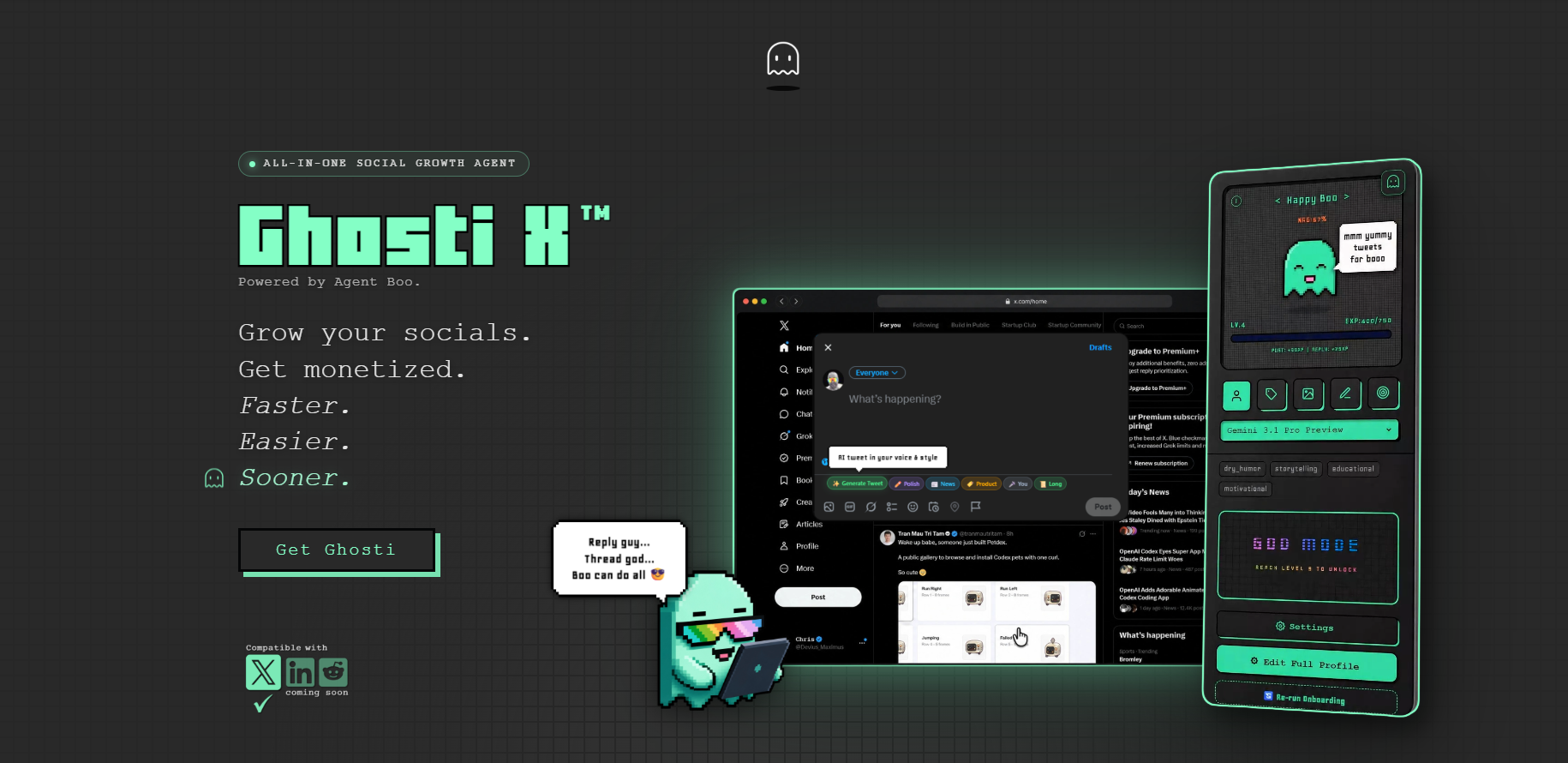
Ghosti is a Chrome extension that lives inside the X feed. No separate dashboard. No copy-paste. You set it up once with your voice, and it generates content right where you scroll.
Here is how it maps to the three agent jobs:
Opportunity discovery: Hunt Mode
Hunt Mode highlights and filters the tweets in your feed that are worth replying to. Instead of scrolling past hundreds of posts trying to spot a good opening, you get a focused view of the conversations where your reply will actually matter. It turns the "find the right thread" step from a 20-minute scroll into a quick scan.
Voice-trained generation: Ghost DNA
Ghost DNA is Ghosti's voice system. During setup you provide your bio, niche, tone preferences, example posts, products, and custom rules. Ghosti uses these inputs to shape its generated content so it reflects your perspective and style, not a generic AI prompt. This is the difference between a tool that generates "content" and one that generates your content.
In-feed replies: Reply Guy
See a post worth replying to? Hit Reply Guy. Ghosti reads the tweet context, generates a contextual reply, and puts it right there in the reply box. No prompting, no separate tab, no pasting. The friction between "I should reply to this" and "done" drops to one click.
Posts, threads, and everything else
Ghosti generates full standalone posts from an empty compose box using your saved interests and examples. Thread Studio turns a topic into a multi-part thread. News reactions, meme replies, product posts, and remixes are all there when you need them, but posts, threads, and replies are the core.
BYOK: your own AI key
Ghosti uses a Bring Your Own Key model. You plug in your own API key from Gemini, OpenAI, Anthropic, or OpenRouter, and pay that provider directly at wholesale cost. No bundled AI metered by daily credits. No generation caps. Pick the model you want and run it.
Visit the Ghosti homepage for current pricing and plan details, plus whatever your AI provider charges for usage.
Boo and the consistency loop
Boo is Ghosti's AI agent mascot. Your activity earns XP. Boo evolves through nine stages, and inactivity fades progress, creating a Tamagotchi-style accountability loop. The point is not a game. It is making the daily habit visible so you actually keep showing up instead of posting for three days and disappearing for two weeks.
Ghosti vs Postwise vs OpenTweet vs Tweet Hunter: side by side
Here is how Ghosti lines up against Postwise and OpenTweet and Tweet Hunter on the dimensions that matter for reply-led growth on X. Every competitor fact below comes from the tool's own official site.
| Feature | Ghosti X | Postwise | OpenTweet | Tweet Hunter |
|---|---|---|---|---|
| Type | Live generation agent | AI ghostwriter for X | Twitter posting API + scheduler for agents | All-in-one AI X growth tool |
| Writes in your voice | ✓ Yes, trained on your examples | ✓ | — | — |
| Generates replies for reply-led growth | ✓ Yes | — | — | — |
| Builds full threads | ✓ Yes, Thread Studio | ✓ | — | ✓ |
| Finds tweets worth replying to | ✓ Yes, Hunt Mode | — | — | — |
| Works inside the X feed | ✓ Yes, native in the feed | — | — | — |
| BYOK — bring your own AI key | ✓ Yes | — | — | — |
| Starting price | $18.99/month | $37 / month (Basic) | From $11.99 / month (7-day free trial) | $49 / month (7-day free trial) |
Postwise is an AI ghostwriter for X that writes in your voice and builds threads. Pricing: $37 / month (Basic).

OpenTweet is a Twitter posting API + scheduler for agents. Pricing: From $11.99 / month (7-day free trial).

Tweet Hunter is an All-in-one AI X growth tool that builds threads. Pricing: $49 / month (7-day free trial).

The takeaway: Ghosti is the pick for creators who want posts, threads, and replies that sound like them, generated in one click right inside X, running on their own AI key.
Making the Agent Habit Stick
Installing a tool is not the same as using it. The difference between people who grow on X and people who install three extensions and quit is consistency, and consistency comes from removing friction.
Here is a realistic daily routine with an agent like Ghosti:
- Morning window (15 minutes). Open X. Turn on Hunt Mode. Scan for a handful of posts from your target accounts that are fresh and on-topic. Hit Reply Guy on each one. Review, tweak if needed, post. That is several thoughtful, on-voice replies before your first meeting.
- One post. Open the compose box, hit Generate Posts. Ghosti writes a standalone post using your Ghost DNA profile. Review, edit, publish. Or open Thread Studio if you have a topic that needs more room.
- End-of-day window (15 minutes). Another round of replies. Check if any earlier replies sparked conversations worth continuing. Boo's XP counter shows the day's activity.
Total active time: maybe 35 minutes. The agent handles the generation; you handle the judgment calls. Over a month of consistent daily use, replies and posts add up quickly, all in your voice, with your Boo leveling up alongside the growth.
Tip: Do not judge results after three days. Reply-led growth compounds. Track profile visits and follows in X analytics over a few weeks. The first week often looks quiet. The third week is where the curve tends to bend.
What to Look for Before You Pick
If you are evaluating AI agents for X beyond this article, here are the five criteria that actually matter:
- Does it generate in your voice? Not from a viral template library. From your examples, your tone, your rules. Ask how the voice training works and what inputs it takes. If it is just a "style" dropdown, it is not voice training.
- Does it work inside X? Every tab switch is friction. Every copy-paste is a reason to quit tomorrow. An in-feed tool removes the gap between seeing a post and replying to it.
- Does it help you find reply opportunities? Generating a reply is half the job. The other half is knowing which threads are worth your time. If the tool has no discovery layer, you are still doing all the scouting yourself.
- What is the AI cost model? Bundled AI with daily caps means you run out mid-afternoon. BYOK means you pay your provider directly for usage, which can offer more flexibility than bundled credit systems.
- Does it need your X password? It should not. Ghosti requires no X password and makes no third-party connection to your account. That is a basic hygiene check for any extension touching your feed.
Run any "AI agent" claim through these five points. Most tools fail on at least two.
Key takeaways
- A real AI agent for X discovers reply opportunities, generates content, and works inside the feed, not in a separate dashboard.
- Experienced creators tend to find that replies tend to boost visibility on X, making reply-led growth a practical strategy grounded in how the platform appears to surface content.
- Voice training matters more than viral templates. Content that sounds like you earns trust and follows; generic AI output does not.
- Ghosti combines Hunt Mode (opportunity discovery), Reply Guy (in-feed reply generation), and Ghost DNA (content personalization) in a single Chrome extension.
- Consistency beats volume. Thoughtful daily replies over weeks outperform sporadic bursts every time.
Frequently asked questions
What is an AI agent for Twitter versus a regular AI writing tool?
A regular AI writing tool generates text in a separate app that you copy into X. An AI agent does more: it discovers which conversations are worth joining, generates posts and replies, and works inside the X feed so you never leave the platform. The distinction is between a text generator and a tool that actively does the legwork of finding, writing, and engaging.
Is it safe to use an AI agent on X?
It depends on how the tool works. X's <a href="https://help.x.com/en/rules-and-policies/x-automation">automation policy</a> addresses automated behavior on the platform. It is widely observed that avoiding spammy or unsolicited automated engagement tends to align with platform expectations. Ghosti is a Chrome extension that generates content for you to review and post. It requires no X password and makes no third-party connection to your account. In practice, it is widely understood that no tool can fully eliminate platform risk, so reviewing what you post and avoiding repetitive or duplicative engagement is a commonly recommended best practice regardless of which tool you use.
How much does Ghosti cost?
Ghosti's license starts at $18.99/month (or $49.99/year). It runs on a Bring Your Own Key model, so you also pay your AI provider (Gemini, OpenAI, Anthropic, or OpenRouter) directly for usage rather than a marked-up, capped AI allowance. See the <a href="https://ghostiapp.com/">Ghosti homepage</a> for current plan details.
Sources
- X For You Feed Algorithm (open-source) (accessed July 9, 2026)
- X automation rules and policies (accessed July 9, 2026)
- Postwise (official site) (accessed July 9, 2026)
- OpenTweet (official site) (accessed July 9, 2026)
- Tweet Hunter (official site) (accessed July 9, 2026)
Editorially reviewed by Chris, Ghosti Founder on .