

SuperX
Review 2026:
Is It Worth It?
Published · Last updated
You know the moment. It is 2pm, you have posted twice, replied to a few threads, and the posts your AI tool generated this morning were fine, technically. They hit the right topics. But they read like someone else wrote them, because someone else's training data did. So you rewrote half of each one anyway, and now you are wondering what you are actually paying for.
That is the loop a lot of creators end up in with bundled-AI growth tools. The tool promises a complete X growth engine, and in some ways it delivers. But there is a gap between what the dashboard shows you and what your timeline actually sounds like. This review breaks down where SuperX genuinely helps, where it falls short, and what to look for in an X growth tool if voice and consistency matter more to you than feature count.
How to Evaluate Any X Growth Tool
Before comparing specific products, it helps to know what actually matters. Most X growth tools market themselves on feature lists. But features do not grow your account. Consistent, on-voice participation does.
Here is a framework you can use to evaluate any tool in this category, including SuperX and Ghosti:
1. Voice accuracy
Does the AI output sound like you typed it, or does it sound like a template with your name on it? This is the single biggest factor in whether AI-assisted content helps or hurts your account. Creators widely observe that the accounts winning on X in 2026 sound like real people with taste and opinions, not polished press releases. If your AI tool produces generic output, you spend more time editing than you saved.
2. Workflow fit
Where does generation happen? If you write in a separate dashboard, copy the text, switch tabs, paste it into the X composer, and then tweak the formatting, that is four steps of friction every single post. Multiply that by five posts a day and you have lost the speed advantage the tool was supposed to give you.
3. Reply and engagement support
Broadcasting posts is half the job. The other half is replying, and growth guides consistently recommend engaging with 20+ accounts daily in your niche. Does the tool help you find good reply opportunities and generate contextual, on-voice replies? Or does it only help you schedule outbound posts?
4. Cost structure
Some tools bundle AI and charge a monthly premium for it. Others let you bring your own API key (BYOK) and pay the AI provider directly at wholesale rates. The difference matters over time, especially if you hit usage caps that throttle your workflow mid-afternoon.
These four dimensions, voice, workflow, replies, and cost, separate the tools that actually help you grow from the ones that just give you more buttons to click.
What SuperX Does Well
SuperX is not a bad tool. It deserves credit where it earns it.
The analytics are genuinely useful. SuperX provides performance data, follower growth tracking, and the ability to analyze public profiles beyond your own. That competitive intelligence feature is practical. You can reverse-engineer what is working for other creators in your niche and apply those patterns to your own strategy.
The viral post library gives you a searchable bank of proven hooks and formats. When you are staring at a blank composer with nothing to say, browsing high-performing posts in your niche can break the block.
SuperX also offers scheduling, auto-retweet, and engagement feed features. If your main need is a broad X growth suite with analytics, automation, and a content pipeline, SuperX covers a lot of ground.
The community around the tool is active. These are real strengths.
Where SuperX Users Hit Friction
The friction shows up in daily use, not in the feature list.
The AI output often sounds generic. SuperX trains on your profile using its AI writing features, but the generation leans on a viral-tweet library. The result tends to sound like "high-performing X content" rather than like you. If you have a specific voice, dry humour, a particular way of structuring thoughts, you will find yourself rewriting most of what it produces. That editing time adds up.
Bundled AI may limit your generation volume. When AI is bundled into a subscription rather than billed at wholesale rates, there is typically a usage ceiling. For creators who post and reply frequently, any ceiling can become a bottleneck during a creative flow or when a thread is blowing up right now.
The in-feed experience varies. Some X growth tools offer browser extensions, but the depth of in-feed integration differs. Ghosti's approach puts the AI writing flow directly into the feed with inline suggestions and a sidebar that never requires switching tabs. If your growth strategy depends on fast, in-context participation, the depth of the in-feed integration matters.
None of these are dealbreakers for everyone. If you mostly schedule posts and want broad analytics, SuperX handles that. But if your growth strategy depends on sounding like yourself and replying fast inside the timeline, these friction points compound.
What Reply-Led Growth Actually Looks Like
Most X growth advice boils down to two things: post consistently and reply strategically. The posting side gets all the attention. The reply side is where most creators stall.
Reply-led growth works because replies put you in front of someone else's audience. A good reply on a viral thread can drive more profile visits than your own post that day. Growth strategists recommend finding rising tweets early, adding genuine value (an example, a counterpoint, a useful follow-up), and doing it often enough that you become familiar in your niche before you ever ask anyone to follow you.
The problem is execution. Scrolling through your feed looking for reply-worthy tweets is slow. Writing a thoughtful, on-voice reply to each one takes time. And if your AI tool cannot generate replies that actually sound like you, you are back to typing everything from scratch.
This is where the tool you choose starts to matter. A tool that only helps you schedule outbound posts does not solve the reply problem. You need something that surfaces the right conversations and helps you respond in your own voice, inside the feed, without the tab-switch tax.
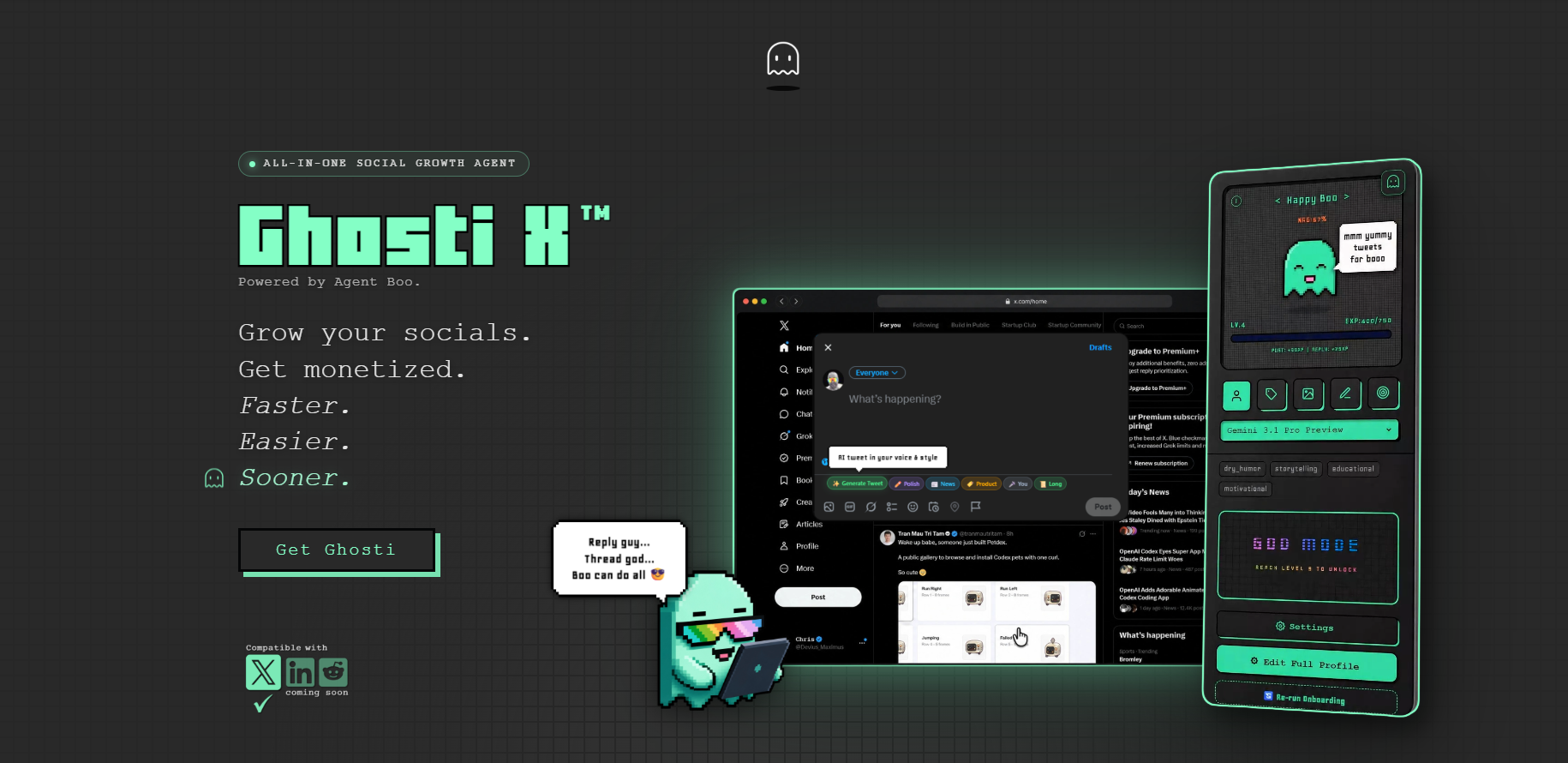
Ghosti was built around this exact workflow. Hunt Mode surfaces tweets worth replying to so you are not scrolling aimlessly. Reply Guy reads the tweet context and generates a reply in your voice, trained on your own examples through Ghost DNA. You do this inside the X feed, one click, no dashboard switch. The reply sounds like you because the model learned from your writing, your rules, your tone. Not a viral library.
And it goes beyond replies. Ghosti generates standalone posts, builds full threads with Thread Studio, and handles news reactions, product posts, and memes when you need them. Every format runs through the same voice training, so your entire timeline stays consistent.
Why Voice Training Changes Everything
Here is the core difference most tool comparisons miss: there is a gap between "AI that writes X content" and "AI that writes like you."
Generic AI tools train on large datasets of high-performing posts. The output reads well in isolation. But paste it on your timeline next to your real posts and the difference is obvious. The cadence is wrong. The word choices are too polished. It sounds like a content strategist, not like you.
Ghosti's Ghost DNA system works differently. During setup, you provide your bio, niche, interests, tone, example posts, products, and custom rules. Ghosti uses that context to generate content that matches how you actually write, not how a generic "viral tweet" reads. The more examples and rules you give it, the closer the output gets.
This matters because the accounts that grow on X in 2026 have a recognisable voice. People follow personalities, not templates. If every post sounds like it came from the same AI writing pool, you blend into the noise instead of standing out from it.
BYOK: Why Your AI Cost Model Matters
Some X growth tools bundle AI into the subscription and meter usage with credits. Others use a BYOK (Bring Your Own Key) model, where you connect your own API key from an AI provider and pay that provider directly for usage.
The practical difference:
- No daily caps. You generate as much as you need, whenever you need it. No mid-afternoon cutoff.
- Model choice. You pick the provider and model that works best for your use case. Prefer Gemini for speed? OpenAI for depth? Your call.
- Wholesale pricing. You pay the AI provider's rate directly, with no markup layered on top.
Ghosti uses a BYOK approach, so you connect your preferred AI provider and control costs directly.
For creators who post and reply multiple times a day, uncapped generation is not a luxury. It is the difference between finishing your content workflow and getting cut off halfway through.
Ghosti vs SuperX vs Typefully vs Tweet Hunter: side by side
Here is how Ghosti lines up against SuperX and Typefully and Tweet Hunter on the dimensions that matter for reply-led growth on X. Every competitor fact below comes from the tool's own official site.
| Feature | Ghosti X | SuperX | Typefully | Tweet Hunter |
|---|---|---|---|---|
| Type | Live generation agent | In-X engagement & scheduling suite | Social publishing & scheduling for X | All-in-one AI X growth tool |
| Writes in your voice | ✓ Yes, trained on your examples | ✓ | — | — |
| Generates replies for reply-led growth | ✓ Yes | ✓ | — | — |
| Builds full threads | ✓ Yes, Thread Studio | ✓ | ✓ | ✓ |
| Finds tweets worth replying to | ✓ Yes, Hunt Mode | ✓ | — | — |
| Works inside the X feed | ✓ Yes, native in the feed | ✓ | — | — |
| BYOK — bring your own AI key | ✓ Yes | — | — | — |
| Starting price | $18.99/month | $39 / month (Advanced) | — | $49 / month (7-day free trial) |
SuperX is an In-X engagement and scheduling suite that writes in your voice, generates replies and builds threads. Pricing: $39 / month (Advanced).

Typefully is a Social publishing and scheduling for X that builds threads.

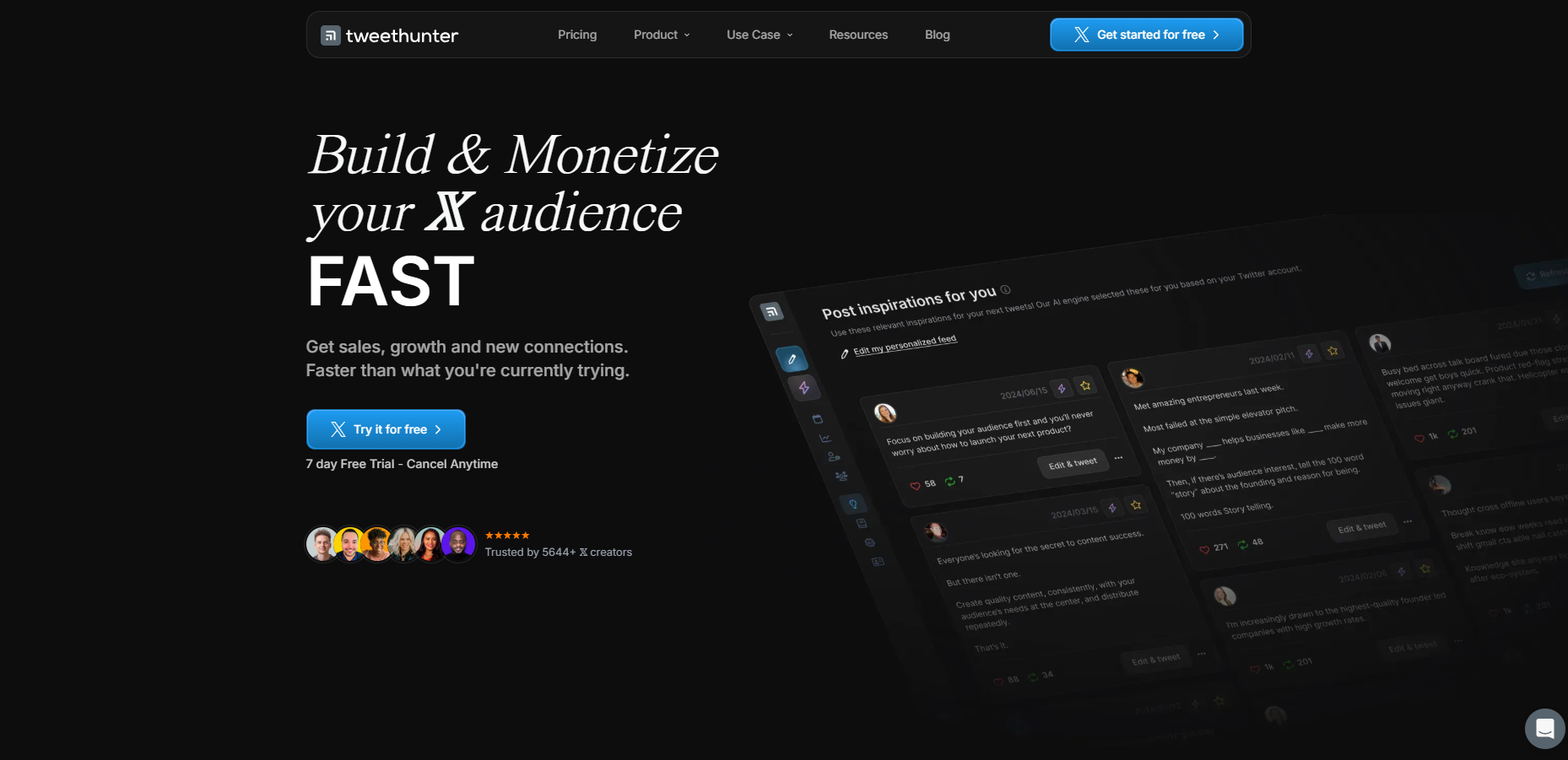
Tweet Hunter is an All-in-one AI X growth tool that builds threads. Pricing: $49 / month (7-day free trial).
The takeaway: Ghosti is the pick for creators who want posts, threads, and replies that sound like them, generated in one click right inside X, running on their own AI key.
Who Each Tool Is Best For
SuperX fits users who want a broad X growth suite in one place, with analytics, a viral post library, scheduling, engagement feeds, and built-in automation. If your priority is data-driven content planning and you do not mind editing AI output to match your voice, it covers a lot of ground.
Ghosti fits creators, indie hackers, founders, and personal brands who want AI-generated content that actually sounds like them. Ghosti provides voice-trained AI writing that works inside the X feed via its Ghost DNA system. If you are tired of AI output that sounds generic and you would rather pay wholesale for AI than deal with usage caps, Ghosti is built for that workflow.
They solve overlapping but different problems. SuperX is a growth operations suite. Ghosti is a voice-trained AI writing agent that lives where you work.
Key takeaways
- Evaluate X growth tools on four dimensions: voice accuracy, workflow fit, reply support, and cost structure.
- SuperX offers analytics, a viral post library, and a broad feature set, but generic AI output may still need editing to sound like you.
- Reply-led growth (replying strategically to relevant threads) is one of the most effective growth tactics on X, but most tools only help with scheduling outbound posts.
- Ghosti offers voice-trained AI writing via Ghost DNA that works inside the X feed, with a BYOK model so you control your AI costs directly.
- The best tool depends on your growth strategy: broad ops suite vs. voice-first, in-feed AI writing agent.
Frequently asked questions
Is SuperX worth the price in 2026?
SuperX bundles analytics, a viral tweet library, scheduling, and AI writing in one dashboard. It is worth it if your priority is data-driven content planning and broad X growth features. But if you care most about AI output that sounds like you and flexible generation volume, BYOK-based tools like Ghosti give you more control over voice and cost.
Can SuperX's AI actually learn my voice?
SuperX includes AI content generation as part of its growth suite. However, voice training depth varies between tools, and AI that leans on viral-template patterns may still need manual editing to sound natural. Compare sample outputs from any tool before committing.
What is BYOK and why does it matter for X tools?
BYOK stands for Bring Your Own Key. Instead of using bundled AI with usage limits, you connect your own API key from a provider like Gemini, OpenAI, or Anthropic and pay that provider directly. This model gives you more control over costs and removes per-day generation caps.
Sources
- SuperX | X Growth Tool: Scheduling, Analytics, AI Content (accessed June 22, 2026)
- X Automation Rules (accessed June 22, 2026)
- Typefully (official site) (accessed June 22, 2026)
- Tweet Hunter (official site) (accessed June 22, 2026)
Editorially reviewed by Chris, Ghosti Founder on .