

How to Get
Monetized on X
Fast in 2026 (New Rules)
Published · Last updated
In about four months, a dormant account with zero history went from nothing to 9,500 followers and $3,661 in X payouts. Daniel Smidstrup did it with no existing audience and no viral moment, mostly by replying to people, a lot, and he screenshotted the payout dashboard the whole way.
Then on 7 August 2026 X changed the rules. Revenue sharing, the program that paid Daniel, stopped taking new members and shut down a month later. Its replacement, Original Content Rewards, excludes replies from the eligibility count and only pays for original posts. So this guide does two jobs. It breaks down what worked for Daniel, and it sorts his playbook into what still gets you monetized fast and what quietly stopped working.
What Getting Monetized on X Requires Now
Monetized on X now means approved for the X Original Content Rewards program, which X announced on 7 August 2026. Per X's help page, the gate is:
- An active X Premium, Premium+ or Premium Business subscription. Basic does not qualify you.
- At least 500 verified followers. Verified, not total. Free accounts following you don't count.
- At least 500,000 Home Timeline impressions from verified users in the last 90 days, with impressions on replies excluded.
- Being 18 or older, in a supported country, with an account in good standing.
- Regularly posting original content, then applying through Creator Studio.
That impression bar works out to about 5,600 qualifying impressions a day for three months. The old revenue sharing bar was 5 million organic impressions, roughly ten times higher. But the new one is filtered hard: only verified viewers, only the Home Timeline, no replies. Which is exactly why the old fast path needs rebuilding.
Why the Old Reply-Only Fast Path Broke
Daniel's 120-day stats show how the old game was won. His account overview shows 9.4 million impressions in a single 30-day window, built mostly through replies rather than viral posts, alongside 88.8K replies in the same stats panel.
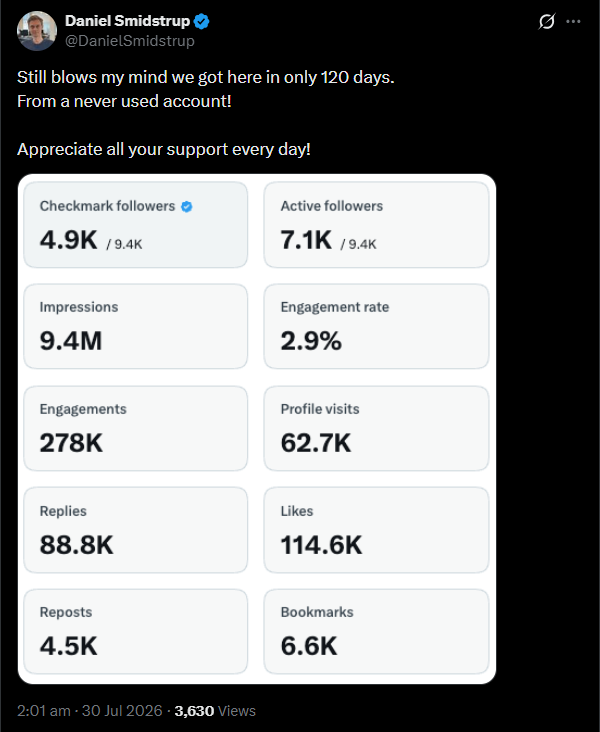
Under revenue sharing, every one of those reply impressions pushed him toward the 5 million threshold. Under Original Content Rewards, impressions on replies are excluded by name. Run the same playbook today and most of those millions would not move your eligibility at all.
But look at the rest of that panel: 4.9K verified followers and 62.7K profile visits. That is the other thing replies do, and it still works. Replies are how strangers find you, click through, and follow. So replies went from being the whole plan to being the growth engine that feeds the posts that pay.
How Much X Paid Under the Old Program
This is the number everyone searches for, so here it is with receipts, and with a clear label: these payouts came from the old revenue sharing program. Daniel posted the screenshot: "X just paid me $788.29 for 445k verified impressions."
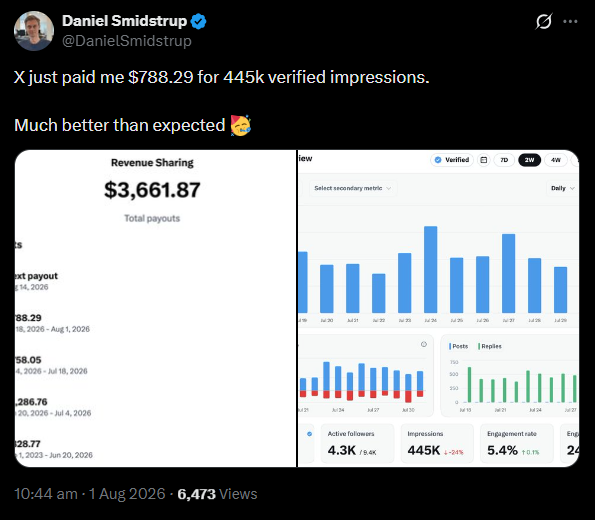
That is about $1.77 per 1,000 verified impressions. An earlier payout, $1,286.76 for a period he reported as 875,000 verified impressions, works out to roughly $1.47 per 1,000. His lifetime revenue sharing total reached $3,661.87 in bi-weekly instalments:
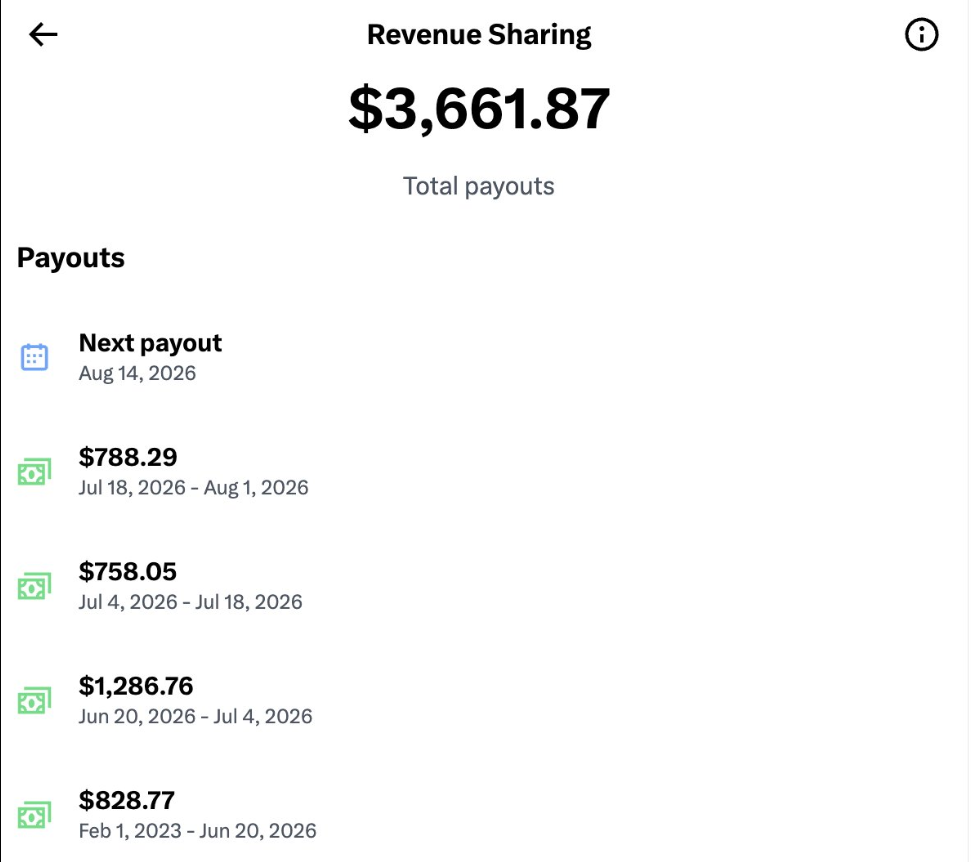
Treat that $1.50 to $1.80 range as history, not a forecast. The new program pays on unique Premium views of original posts, draws on its own pool, and X has not published a rate for it. What carried over is the rhythm: payouts every two weeks, with a $30 minimum under X's monetization standards.
Step 2: Use Conversation Posts to Grow, Originals to Earn
Daniel found a handful of post shapes that reliably pulled replies, then ran them on repeat. Here they are with his real numbers, sorted by what each one does for you under the new rules:
- The community connect post (growth). "Hey founders, what are you building today? Let's connect." His best format, once pulling 360 replies and nearly 20,000 views. Great for followers. Thin on originality, so it is a weak sample for your application.
- The this-or-that (growth). "If you had $200, what would you choose: codex, cursor, or claude code?" pulled 195 replies. Forcing a pick is easier to answer than an open question.
- The opinion hook (growth and earning). "USA has ChatGPT, Grok, Claude, Gemini. China has DeepSeek, Qwen, Kimi. Europe has?" did 28,000 views and 151 replies. A clear take is exactly what X calls original commentary.
- The receipt (growth only). His payout and milestone posts cleared 30,000 views. But X now rules out content "exclusively focused on monetization coaching, monetization discussion, or maximizing payouts." Payout screenshots can still win followers. They won't earn.
So run two sets of formats. Keep one or two conversation starters for growth, and build three or four original formats for earning: a take with the reasoning attached, a build-in-public update with real numbers, a teardown of something in your niche, a lesson from something you tried. One warning on the conversation posts: an open question is fine, but X can remove accounts from the program for repeatedly "asking to like, reply, bookmark, follow, or repost." "Comment YES and I'll DM you" is on the wrong side of that line.
Step 3: Reply to Win Verified Followers
Now the part that compounds. Replying no longer counts toward the impression bar, but it is still the fastest way to build the audience that makes the bar reachable. Two moves, on repeat:
- Reply to everyone who engages with you. Every reply adds engagement to your post, which is the signal the algorithm uses to show it to more people, and the people you reply to tend to follow.
- Reply early under bigger accounts in your niche. A sharp reply near the top of a popular thread puts you in front of that account's whole audience, and a good share of them in these niches are Premium.
Track verified followers, not total followers. Daniel reached 4.9K verified followers in 120 days, almost ten times the 500 the program needs, and his follower log shows why patience pays: his first 1,000 followers took 33 days with almost no traction, then 1k to 2k took 7 days and 2k to 3k took 8. The work barely changed. The audience compounding is what flipped it.
The shift is in where the payoff lands. Those followers now see your original posts in their Home Timeline, and that is where the qualifying impressions come from. For the full reply method, see how to grow on X with replies.
Step 4: Apply With Your 10 Most Original Posts
Once Creator Studio shows you meet the requirements, apply under Original Content Rewards. Creators who have been through it report that X asks you to pick the 10 posts that best represent your original work from a selection of recent ones. Choose the most clearly yours, not the most viral. A personal lesson with 20,000 views is a stronger sample than a this-or-that with 200,000.
X says it reviews applications within three business days. If you are turned down, you get one appeal, and after that you can reapply in 90 days if you still meet the requirements. That 90-day wait is the real cost of applying too early with a feed full of conversation bait, so apply when your recent posts make the case for you.
What It Actually Takes
The honest answer to how to get monetized on X fast: it is simple, but it is not instant. Averaging 5,600 qualifying impressions a day is a real climb for a new account, and the first month is the real test. When your first 1,000 followers take a month and most posts land flat, it feels like shouting into an empty room. That quiet stretch, right before the snowball catches, is where almost everyone quits.
The work itself is not hard. It is short replies to grow, and honest, specific posts to earn, repeated for months. The challenge is volume and consistency, especially early when the feedback is thin. That is good news if you are starting now, because the replying is exactly the part the right tools take off your plate.
The Tools That Make the Volume Doable
The strategy is a lot of small actions: a reply to everyone who engages, replies under the right bigger posts, and a daily original post. A focused stack keeps it from becoming an all-day job.
- The reply volume, in your voice. This is the bottleneck, and it is what Ghosti is built for. It is a Chrome extension that works inside the X feed: Hunt Mode surfaces the posts worth replying to, and Reply Guy generates an on-brand reply in one click, sounding like you through Ghost DNA rather than generic AI. That is the piece that takes hours by hand and minutes with help.
- Turning your own ideas into posts. The posts you want paid for should carry your own take. When you have the idea, a lesson or something you shipped, Ghosti's post generator and Thread Studio turn it into a post or thread in your voice, so the blank box stops being the bottleneck. Because it uses your own AI key, the model is your choice and you pay the provider directly, at their rates.
- Tracking your progress to the threshold. Creator Studio tells you where you stand against each requirement, and X's own post analytics show which posts are actually pulling impressions.
Ghosti handles the part that eats your day, and your own thinking handles the part X pays for. Plans and the free trial are on ghostiapp.com.
Key takeaways
- Getting monetized on X now means approval into Original Content Rewards: X Premium, 500 verified followers, and 500,000 Home Timeline impressions from verified users in 90 days, replies excluded.
- The old fast path, stacking millions of reply impressions, no longer moves your eligibility. Replies now build followers; original posts earn.
- Daniel Smidstrup's run shows the growth side still works: 4.9K verified followers in 120 days, with the first 1,000 followers taking 33 days and the next 1,000 taking 7.
- Payout screenshots and other monetization-talk posts can grow you but won't earn, and repeatedly asking people to like, reply or repost can get you removed.
- Old revenue sharing rates of roughly $1.50 to $1.80 per 1,000 verified impressions are history. X has not published a rate for the new program.
Frequently asked questions
How fast can you get monetized on X now?
Months, not weeks, for most new accounts. You need 500 verified followers and 500,000 Home Timeline impressions from verified users over 90 days, which averages about 5,600 qualifying impressions a day. Daniel Smidstrup reached 4.9K verified followers in 120 days by replying at high volume, which shows the follower side can move fast. The impression side now depends on your own original posts, not your replies, so it rewards consistency more than any single sprint.
How many followers do you need to get monetized on X?
At least 500 verified followers, meaning followers who subscribe to X Premium. Free accounts following you do not count toward the requirement. You also need 500,000 Home Timeline impressions from verified users in the last 90 days and an X Premium, Premium+ or Premium Business subscription.
Do replies count toward X monetization?
Not anymore. X's Original Content Rewards program excludes impressions on replies from its 500,000 impression requirement. Replies are still one of the best ways to grow, because they put you in front of new people who then follow you and see your original posts, but they no longer count toward eligibility.
How much does X pay per 1,000 impressions?
X has not published a rate for Original Content Rewards. Under the old revenue sharing program, Daniel was paid $788.29 for 445,000 verified impressions, about $1.77 per 1,000, and an earlier payout came out near $1.47. Treat those as historical. The new program pays on unique Premium views of original posts, so wait for a few payout cycles before trusting any new figure.
Do you need X Premium to make money on X?
Yes, for X's own payouts. Original Content Rewards requires X Premium, Premium+ or Premium Business, and Basic does not qualify you. Premium matters on the other side too: only views from Premium subscribers count as qualified impressions, which is why niches full of paying users earn more.
How many times a day should you post and reply to get monetized fast?
There is no official number. Daniel averaged about ten short posts a day and replied to most people who engaged. Under the new rules, aim for at least one genuinely original post a day for earning, plus a steady stream of replies for growth. Consistency over months matters more than any single day.
How do you get paid to tweet on X?
<p>X pays through its Original Content Rewards program: once approved, you earn every two weeks based on unique views from Premium subscribers of your original posts in the Home Timeline. There is no flat "paid per tweet" rate. The other ways to get paid to tweet are indirect: paid subscriptions to your account, sponsorships you negotiate, and selling your own product to the audience your posting builds. Our guide to <a href="https://ghostiapp.com/blog/posts/how-to-make-money-on-x.html">how to make money on X</a> covers all four.</p>
Sources
- Original Content Rewards Program (X Creators announcement) (accessed September 28, 2026)
- Original Content Rewards Program (X Help Center) (accessed September 28, 2026)
- X's Creator Monetization Standards (X Help Center) (accessed September 28, 2026)
- Daniel Smidstrup, X payout breakdown ($1,286.76, 7 hrs/day, 7,437 replies) (accessed August 4, 2026)
- Daniel Smidstrup, 9k followers in 106 days growth breakdown (accessed August 4, 2026)