

OpenTweet
Review 2026
Published · Last updated
You've probably seen OpenTweet mentioned in a thread, an ad, or a listicle recently. The landing page looks promising, especially if you're exploring AI growth tools for X (Twitter). But before you invest your time or money, you want a real take, not another affiliate fluff piece. Most reviews of niche X tools gloss over what actually matters for daily consistency: voice fidelity, workflow friction, and whether the tool actually helps you join conversations. Let's break down exactly what OpenTweet does, where it shines, how to evaluate any X tool, and whether it's the right fit for your workflow.
The four pillars of an effective X (Twitter) tool
Before diving into OpenTweet, it helps to understand what actually moves the needle on X today. A good tool shouldn't just schedule posts; it should solve the core problems of consistency and audience growth. Here is the practical evaluation framework you should use to judge OpenTweet, or any alternative.
Voice fidelity: Does it sound like you?
The biggest problem with AI writing tools is that they tend to sound like generic robots. If a tool relies on viral templates, your audience will notice, and they will tune out. You need a tool that trains on your own examples, your niche, and your specific tone. Voice fidelity is the difference between building a personal brand and running a spam account.
Workflow fit: In-feed vs. separate dashboards
Friction kills consistency. If you have to open a separate dashboard, write your content, schedule it, and then log into X to engage with people, you are wasting time. The best tools work directly inside the X feed, allowing you to generate posts and replies without switching tabs. When your workflow is seamless, you show up more often.
Reply and engagement support
Scheduling standalone posts is not enough. X's open-source algorithm specifically predicts the probability of a reply. According to X's own code, replies are a first-class signal in the ranking model. A tool that only schedules posts is missing half the game. You need active reply discovery, a way to find the conversations worth joining and draft contextual replies quickly.
Pricing model: Bundled credits vs. BYOK
Many tools lock you into a subscription that bundles a limited number of AI generations per day. If you hit your cap, you stop growing. A Bring Your Own Key (BYOK) model is almost always better. It allows you to plug in your own API key (like Gemini or OpenAI) and pay wholesale usage costs directly to the provider, giving you choice and eliminating daily limits.
How to grow an audience while evaluating tools
Tools only amplify your existing strategy. If your underlying approach is flawed, no API or scheduler will save it. Creators widely observe that growth on X compounds through consistent, high-quality interactions rather than viral hacks. Here are the core tactics you should implement, regardless of which software you ultimately choose.
Write replies people actually stop to read
Creators widely observe that optimizing for replies tends to also increase dwell time and profile clicks. A reply that is genuinely worth reading, a specific counter-take, a concrete detail, or a small story, gives a reader a reason to stop, click your profile, and follow. Remember, X's open-source recommendation algorithm predicts these actions to determine what appears in the For You feed.
Pick conversations by relevance over raw follower count
The highest-converting reply target is usually a mid-sized account whose followers are the exact people you want to reach. A giant off-topic account is worse than a smaller on-topic one because replies only convert when the onlookers actually care about your niche. In practice, keeping a short list of accounts your ideal followers already read works best. Catching a conversation early, while the thread is still live, helps your reply be seen near the top.
Run a sustainable cadence
Reply growth compounds through consistency, not bursts. A repeatable system most creators can actually sustain is short daily windows, posting thoughtful replies concentrated on relevant accounts while their posts are fresh. A handful of strong replies every day beats a frantic session and silence after. Build it into an existing habit, like having your morning coffee or winding down at the end of the day, so it survives a busy week.
Measure over weeks with profile clicks and follows, not reply likes
Replies are a slow-compounding channel, so judging them day-to-day will make you quit a working strategy. Track the right things over a multi-week window: profile visits and follows, plus whether specific accounts start recognizing and replying back to you. A reply that got few likes but sent a few people to your profile did its job; a witty one-liner that got likes but no profile clicks did not. Review your analytics monthly and double down on the conversations and angles that actually moved profile visits.
What OpenTweet does well
Now let's apply this framework to OpenTweet. OpenTweet positions itself as a Twitter/X posting REST API and scheduler. Its primary strength is acting as the plumbing that lets AI agents publish to X without requiring official Twitter API keys.
It is cheap, starting at $11.99 per month (or $9.99 per month billed annually), and OpenTweet reports solid traction, citing over 5,500 active creators. It also works with agent frameworks, including OpenClaw. If you are a developer piecing together your own automated workflow, it provides a very simple bridge to the timeline.
Where OpenTweet falls short
The limitations of OpenTweet become clear when you look at it through the lens of a creator rather than a developer. OpenTweet is built as infrastructure: it gives you a reliable way to publish to X, but it does not run inside the feed where the conversations actually happen. There is no in-feed workflow, so you are still moving between your own tooling and the timeline.
It also leaves the growth strategy to you. There is no built-in reply discovery to surface the conversations worth joining, and no equivalent of a Hunt Mode to find high-opportunity threads in your niche. You wire up the pieces and drive the approach yourself. For a developer who wants a clean bridge to the timeline, that is exactly the point. For a creator who just wants to show up consistently and grow, it is a lot of assembly before you write your first reply.
OpenTweet pricing
OpenTweet's pricing is straightforward. It starts from $11.99 per month, which includes API access. They also offer a 7-day free trial, allowing you to test out your custom agent integration before committing.
Who OpenTweet is for
OpenTweet is genuinely best for developers and tinkerers who want a cheap, simple way to make their own agent or workflow post to X. If you enjoy building custom integrations and just need a reliable endpoint to send your generated text to, OpenTweet handles that exact job well.
Ghosti vs OpenTweet: side by side
Here is how Ghosti lines up against OpenTweet on the dimensions that matter for reply-led growth on X. Every competitor fact below comes from the tool's own official site.
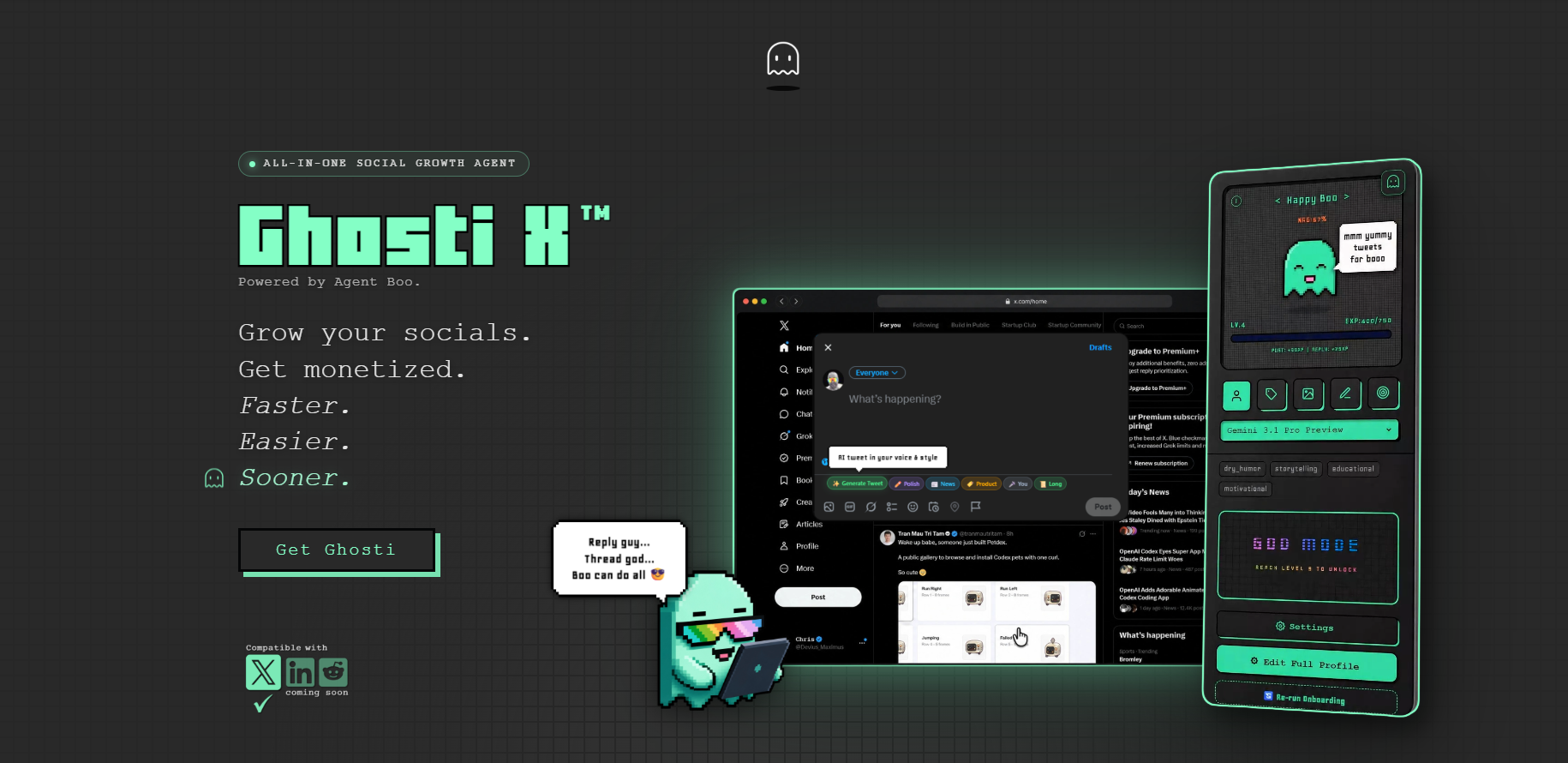
| Feature | Ghosti X | OpenTweet |
|---|---|---|
| Type | Live generation agent | Twitter posting API + scheduler for agents |
| Writes in your voice | ✓ Yes, trained on your examples | — |
| Generates replies for reply-led growth | ✓ Yes | — |
| Builds full threads | ✓ Yes, Thread Studio | — |
| Finds tweets worth replying to | ✓ Yes, Hunt Mode | — |
| Works inside the X feed | ✓ Yes, native in the feed | — |
| BYOK — bring your own AI key | ✓ Yes | — |
| Starting price | $18.99/month | From $11.99 / month (7-day free trial) |
OpenTweet is a Twitter posting API + scheduler for agents. Pricing: From $11.99 / month (7-day free trial).

The takeaway: Ghosti is the pick for creators who want posts, threads, and replies that sound like them, generated in one click right inside X, running on their own AI key.
OpenTweet vs Ghosti
Choosing between OpenTweet and Ghosti comes down to whether you want to build the plumbing or just start writing.
OpenTweet is a posting API, the infrastructure that lets a developer's agent publish to X. You still have to build or wire up the agent yourself.
Ghosti is the actual writing product a creator uses. It generates posts, threads, and replies in one click directly inside the X feed. With Ghost DNA, it trains on your own examples to sound like you, rather than a generic template, starting much closer to your style than a blank prompt.
It needs no X password and makes no dodgy third-party connection to your account.
If you want to spend your time building a custom agent pipeline, OpenTweet is a solid choice. But if you want to grow your audience with an AI writing agent that does the legwork for you right inside X, Ghosti is the better tool for the job.
Key takeaways
- OpenTweet is a REST API designed to connect AI agents to X without official API keys.
- It integrates well with frameworks like OpenClaw, starting at $11.99/month.
- OpenTweet acts as the plumbing that lets your own agents publish to X; the writing, reply discovery, and in-feed workflow are left to you.
- Ghosti is the better alternative for creators who want a ready-to-use AI writing agent that works directly inside the X feed.
Frequently asked questions
What is OpenTweet?
OpenTweet allows AI agents to publish to X without official Twitter API keys. It works with tools like OpenClaw.
Is OpenTweet free?
Pricing starts at $11.99 per month.
Sources
- OpenTweet (accessed June 28, 2026)
- X For You feed algorithm (accessed June 28, 2026)
- X automation rules (accessed June 28, 2026)
Editorially reviewed by Chris, Ghosti Founder on .