

Tweet Hunter
Review 2026:
What You Need to Know
Published · Last updated
Try searching "tweet hunter review" right now. You'll find affiliate posts from 2023 that still quote old pricing, walkthroughs that look like they were written from the same press release, and Reddit threads where half the replies are bots. Not exactly helpful when you're trying to decide whether a $49/month tool fits how you actually use X in 2026.
We build Ghosti, so we're biased, and we'll be transparent about that throughout. But this review is built around a practical framework for evaluating any AI writing tool for X, so it's useful whether you end up trying Ghosti or not. Let's get into what Tweet Hunter actually does, where it earns its reputation, and where certain types of creators run into real friction.
Four Things That Matter When Picking an AI X Tool
Most reviews list features without telling you which ones change your results. Before looking at any specific product, here are the four dimensions that separate a tool you'll actually use from one that collects dust after a free trial.
Voice fidelity
The most common complaint across AI writing tools for X is that the output sounds generic. Tools that generate from a library of high-performing tweets are optimising for "what went viral for someone else," not for how you specifically write. That works if you're fine rewriting most of the output. It falls apart when the whole point was saving time.
The alternative is voice training: a tool that learns from your examples, your tone, your context, and generates output that already sounds closer to you. The editing gap between raw AI output and something you'd actually post is the real productivity metric here.
Workflow integration
Dashboard tools pull you out of X to write. For creators who run a content calendar, that makes sense. For creators who spend most of their time in the feed, replying and joining conversations, the tab-switching friction adds up fast. Some people stop using the tool entirely because opening a separate app feels like one more chore on a busy morning.
AI cost model
Bundled AI means the tool includes generation in your subscription, often metered by credits or locked behind higher tiers. Connecting your own API key (BYOK) means you pay the AI provider directly. You get model choice, no per-day caps, and typically lower total cost if you're generating regularly. Bundled is simpler but locks you in.
Reply support
Creators widely observe that replies tend to carry meaningful weight in X's ranking alongside favourites, reposts, and other engagement signals. In practice, replies aren't just a growth hack, they tend to function as a significant signal in how X decides what to show people. If replies are part of your growth strategy, you need a tool that helps you find the right conversations and write contextual replies, not just schedule outbound content.
A Reply Strategy That Works Without Any Tool
This is free. It works whether you use Tweet Hunter, Ghosti, or nothing at all. It's grounded in how X's algorithm actually scores engagement, and it's what experienced creators consistently report working.
Build a focused target list
Creators widely observe that the highest-converting reply targets are mid-sized accounts in your niche, often a few times your follower count, whose audiences overlap with the people you want to reach. A reply under a massive off-topic account rarely converts because the readers don't care about your subject. Keep a short list of 15 to 30 accounts your ideal followers already read.
Two short windows, not one marathon
Reply growth compounds through consistency, not bursts. In practice, many creators find that two short daily windows, producing a focused batch of considered replies concentrated on your target list, outperform a single frantic session followed by days of silence. Pin the habit to something already in your routine. Morning coffee, end-of-day wind-down. Whatever survives a busy week.
Write replies worth stopping for
X's ranking model predicts dwell time, profile clicks, and follow actions among its scored signals. A reply with a specific counter-take, a concrete detail from your experience, or a brief relevant story gives readers a reason to pause, click your profile, and follow. A "great post!" does none of that. The test: could only you have written this reply, or could any account in the niche have said the same thing?
Measure over weeks, not days
Replies are a slow-compounding channel. Judging them day-to-day makes you quit a working strategy. Track profile visits and new follows in X analytics over several weeks. A reply that got zero likes but sent three people to your profile did its job. A witty one-liner that got likes but no profile clicks did not. Review monthly and double down on the angles that actually moved profile visits.
A handful of strong, on-voice replies every day beats a frantic marathon of generic ones.
What Tweet Hunter Does Well
Tweet Hunter has been around for years and earned a real reputation as a comprehensive X growth suite. It offers AI tweet writing, a scheduling system, built-in automation, and a CRM for tracking leads.
The operational layer is where Tweet Hunter genuinely delivers. If your workflow involves managing a content calendar, tracking leads from X conversations, scheduling outbound posts across time zones, and automating repetitive engagement tasks, having all of that in a single dashboard saves you from stitching together three or four separate products. The viral-tweet library and inspiration engine are also a real asset if you treat them as idea fuel rather than copy-paste templates.
For established creators and solo marketers who actively use the scheduling, CRM, and automation features and can justify the spend, Tweet Hunter covers ground that lighter tools simply don't try to.
Where Tweet Hunter Falls Short
The most persistent criticism of Tweet Hunter across long-term users isn't about missing features. It's about the AI voice. When a tool generates from a library of existing high-performing tweets, the output tends toward a remix of what worked for other people. The AI is optimising for past performance across thousands of accounts, not for one specific creator's voice and patterns.
For some people, that's fine. They treat the output as a jumping-off point and rewrite heavily. But for founders, indie hackers, and personal brands who've spent months developing a distinct tone, the editing overhead can eat the time the tool was supposed to save. You end up rewriting almost everything, which is essentially the blank-page problem with an extra step.
The second friction point is the dashboard itself. Tweet Hunter works from a separate web app. That design makes sense for content operations. But for creators who spend most of their X time in the feed, looking for conversations to join and tweets worth replying to, the context switch adds up. You spot a post worth engaging with, but your writing tool is in another tab. By the time you switch, the thread has moved on.
The third consideration is pricing. Tweet Hunter costs $49/month (with a 7-day free trial). For a full suite you use daily, that can be justified. But for bootstrapped founders and early-stage creators who mainly need a writing tool that sounds like them, it's a significant monthly commitment, especially when some of the richer AI features sit on higher tiers.
None of these are product flaws. They're a mismatch between how certain types of creators work and what the tool was designed to optimise for.
Tweet Hunter Pricing
Tweet Hunter starts at $49/month with a 7-day free trial. That gets you the core suite of scheduling, automation, and CRM features, while AI writing requires the superior plan. The pricing reflects what Tweet Hunter is: a full-featured growth platform, not a single-purpose writing tool. For creators who use the complete stack daily, the value math works. For those who mainly need AI writing help, it's worth asking whether you're paying for operational features you won't touch.
Who Tweet Hunter Is For
Tweet Hunter is the right pick for established creators and solo marketers who genuinely need a full X growth suite: scheduling, automation, lead CRM, analytics, and AI writing bundled together. If you manage a content operation and your day involves queuing posts across time zones, auto-DMing users who interact with your tweets, tracking leads from engagement, and browsing a viral-tweet library for content angles, Tweet Hunter consolidates those jobs into one dashboard. That consolidation is its real value.
It's a harder sell for creators whose primary frustration is that AI output doesn't sound like them, or who live inside the X feed and want their writing tool to meet them there instead of pulling them into a separate app.
Ghosti vs Tweet Hunter vs Typefully vs Hypefury: side by side
Here is how Ghosti lines up against Tweet Hunter and Typefully and Hypefury on the dimensions that matter for reply-led growth on X. Every competitor fact below comes from the tool's own official site.
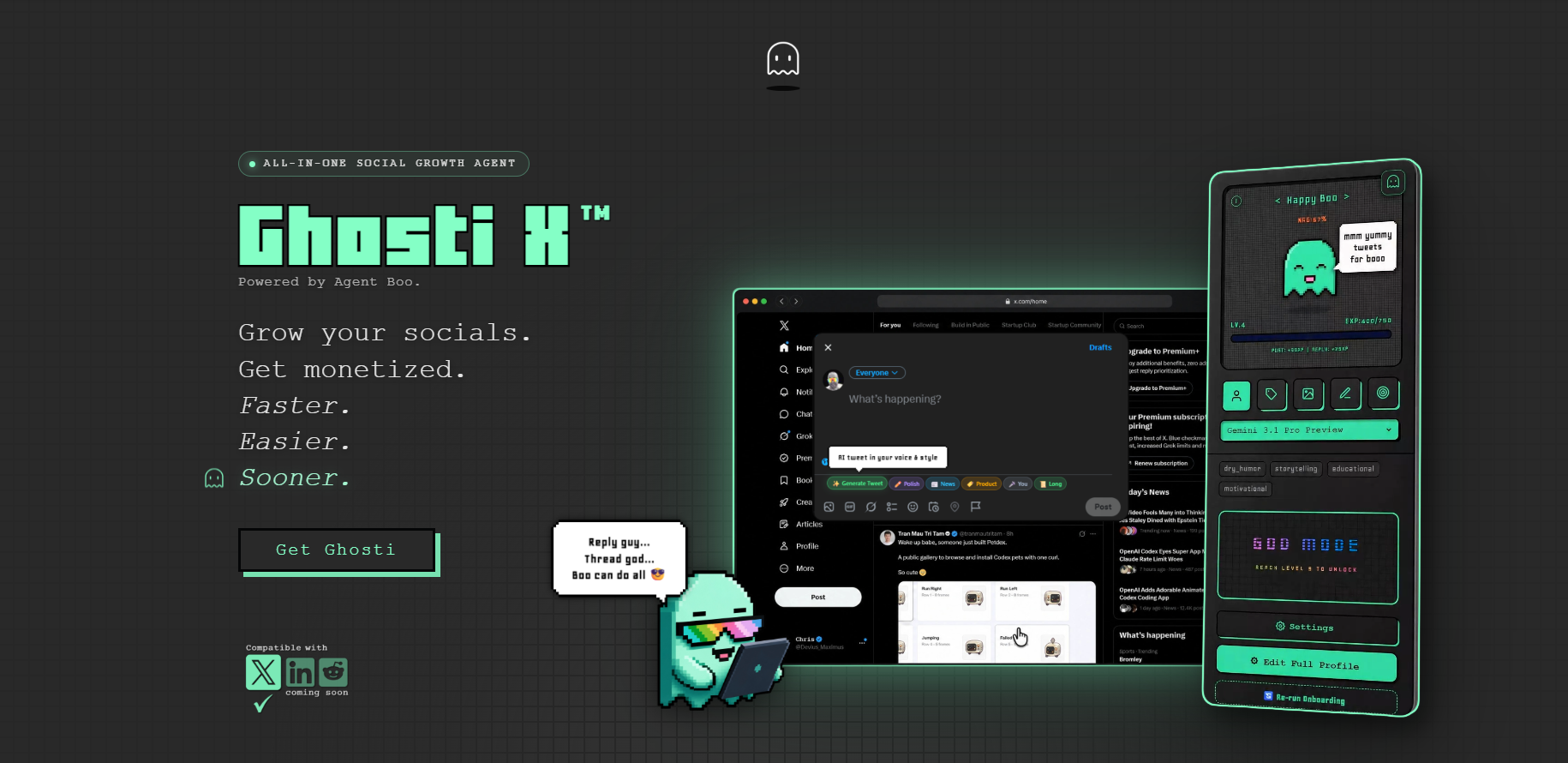
| Feature | Ghosti X | Tweet Hunter | Typefully | Hypefury |
|---|---|---|---|---|
| Type | Live generation agent | All-in-one AI X growth tool | Social publishing & scheduling for X | Social scheduling & automation suite |
| Writes in your voice | ✓ Yes, trained on your examples | — | — | — |
| Generates replies for reply-led growth | ✓ Yes | — | — | ✓ |
| Builds full threads | ✓ Yes, Thread Studio | ✓ | ✓ | ✓ |
| Finds tweets worth replying to | ✓ Yes, Hunt Mode | — | — | ✓ |
| Works inside the X feed | ✓ Yes, native in the feed | — | — | — |
| BYOK — bring your own AI key | ✓ Yes | — | — | — |
| Starting price | $18.99/month | $49 / month (7-day free trial) | — | — |
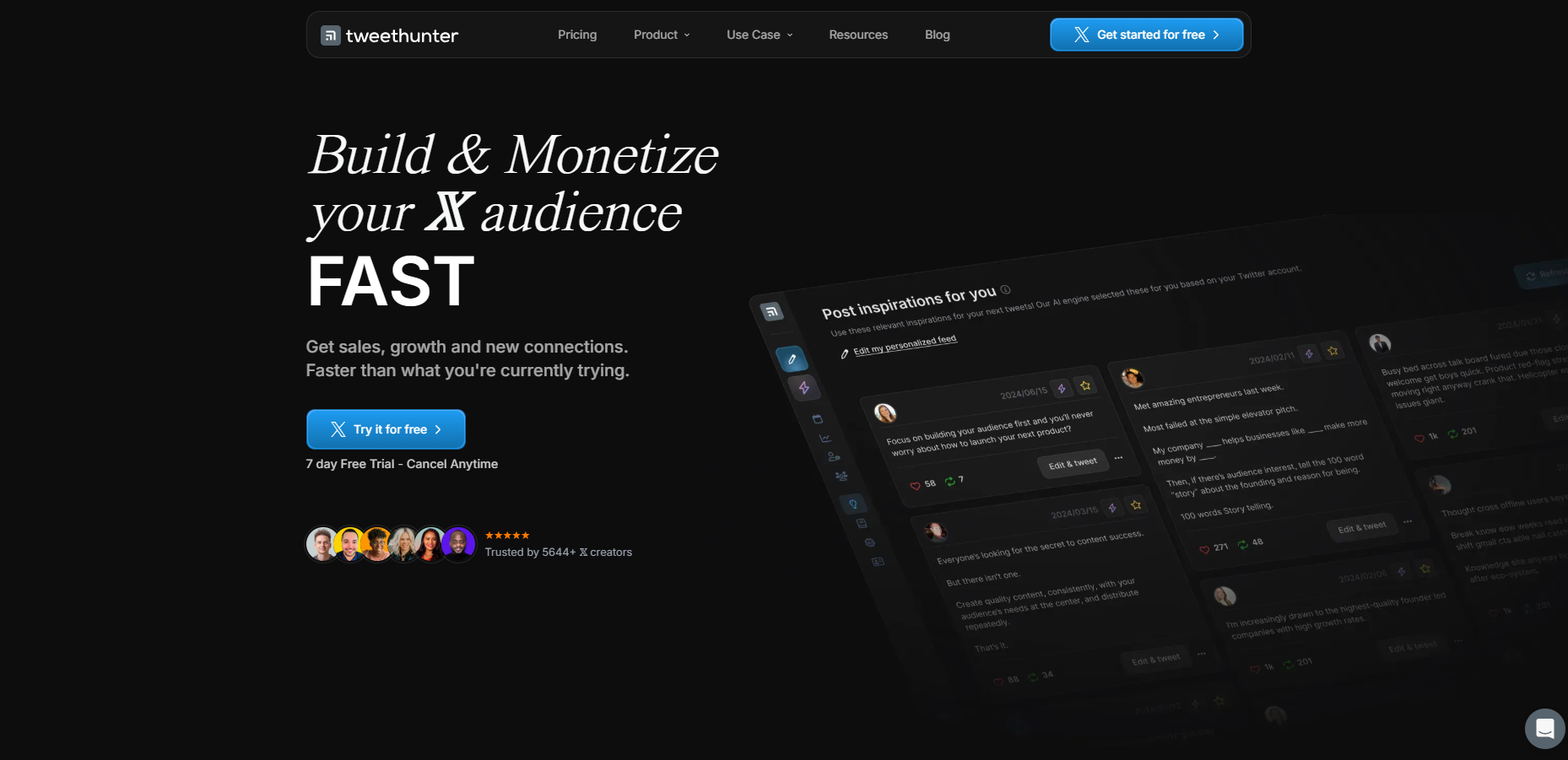
Tweet Hunter is an All-in-one AI X growth tool that builds threads. Pricing: $49 / month (7-day free trial).
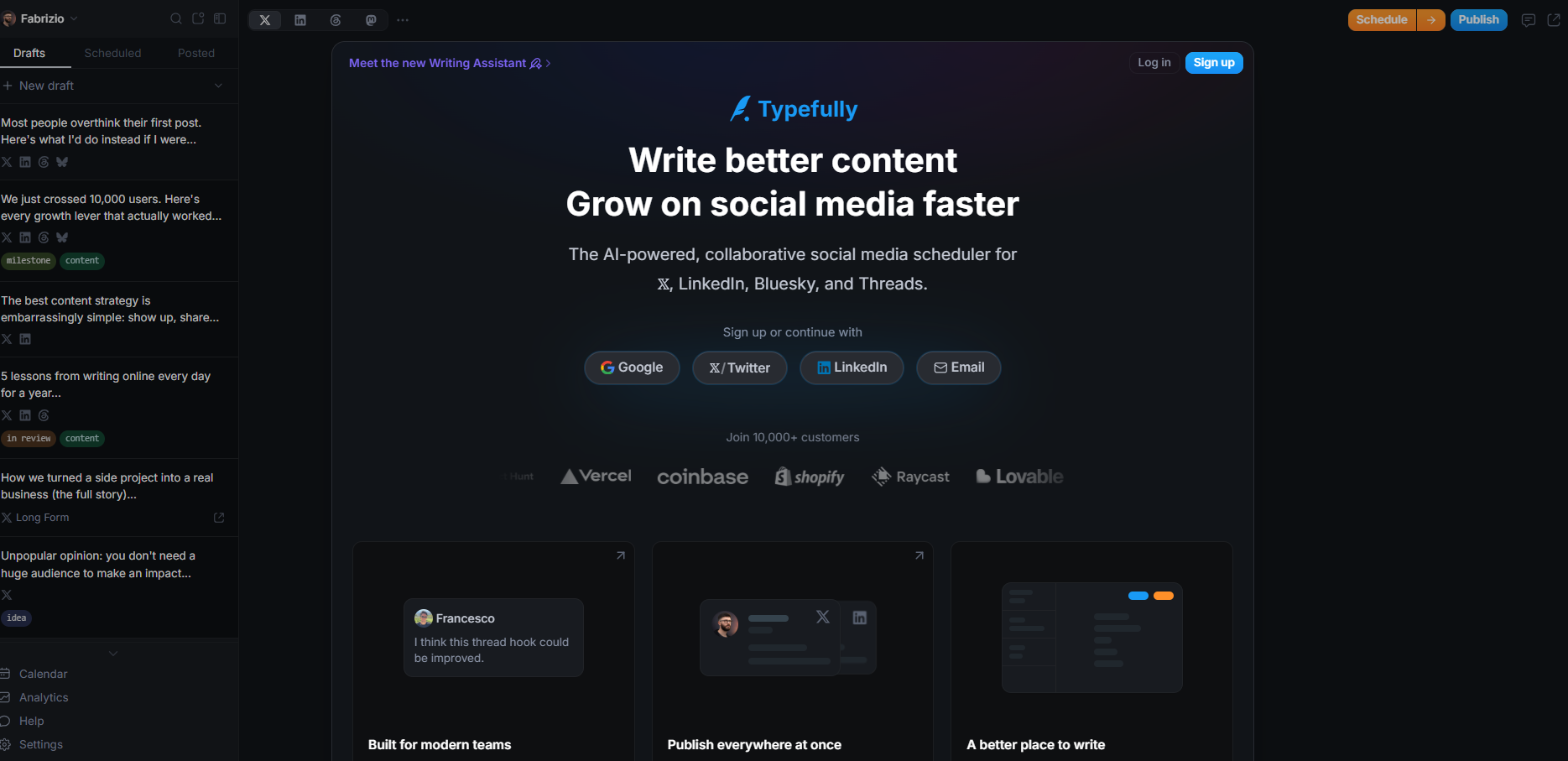
Typefully is a Social publishing and scheduling for X that builds threads.
Hypefury is a Social scheduling and automation suite that generates replies and builds threads.

The takeaway: Ghosti is the pick for creators who want posts, threads, and replies that sound like them, generated in one click right inside X, running on their own AI key.
Tweet Hunter vs Ghosti: A Different Design Philosophy
We're biased, so here's the reasoning laid out plainly, and you can decide whether it fits how you actually work on X.
Voice trained on your examples (Ghost DNA)
Ghost DNA doesn't remix a viral-tweet library. It learns from your own examples, your tone preferences, your rules, and your context. You teach it how you write, and it generates posts, replies, and threads that start closer to your actual voice. The gap between raw output and something you'd actually post gets smaller, which means less editing and more time in the conversations that matter.
Generates inside the X feed
Ghosti is a Chrome extension designed to work inside the X feed, where you can generate posts and replies without leaving X. No separate dashboard, no copy-paste, no tab switching.
Hunt Mode finds the replies worth writing
The reply strategy from earlier works, but the tedious part is scrolling your feed hunting for the right conversations. Hunt Mode surfaces relevant tweets from accounts you care about, so you spend your time engaging instead of searching. Paired with Reply Guy generating the contextual reply in your voice, the daily reply habit becomes realistic instead of aspirational.
Your own AI key, no caps
Ghosti uses BYOK. You plug in your own API key from Gemini, OpenAI, Anthropic, or OpenRouter. You pay the provider directly at wholesale rates, pick whatever model you want, and there are no per-day generation limits. No AI features locked behind a higher pricing tier. At $18.99/month or $49.99/year, the Ghosti license itself costs a fraction of a full suite, and your AI usage costs roughly ~$5/month for around 1,000 generations.
One quiet bonus: Ghosti needs no X password and makes no third-party connection to your account. It works inside the browser you're already logged into.
Making the Reply Habit Actually Stick
Here's the honest problem with any strategy: it only works if you do it past the first week. The reply framework above is effective, but most people quit after three or four days because the friction between "I should reply to this" and "done, posted" is just high enough to lose to a busy morning.
This is where design decisions compound in practice. Hunt Mode removes the "finding posts" friction. Reply Guy removes the "writing the reply" friction. Ghost DNA keeps the output sounding like you so there's no rewriting step between generation and posting. The mechanical friction between intention and action is what separates a strategy you run for two weeks from one you sustain for six months.
Boo's XP loop adds a visible progress tracker on top. Activity earns XP, Boo evolves through stages, and the daily habit stays in sight even when the growth numbers haven't caught up yet. It's a small thing, but consistency is the hard part, and anything that makes showing up feel like progress instead of a chore changes whether you stick with it.
The Bottom Line on Tweet Hunter
Tweet Hunter is a legitimate, feature-rich X growth platform with real strengths in scheduling, automation, CRM, and a deep viral-tweet library. For creators and marketers who run a content operation and use the full suite, it earns its $49/month.
If your biggest frustration is different, if AI output doesn't sound like you, if you lose time switching between a dashboard and the feed, if you want an agent that finds the tweets worth replying to and generates contextual replies in your trained voice, all on your own AI key, that's what Ghosti is built for. Ghost DNA voice training, in-feed generation, Hunt Mode reply discovery, and BYOK pricing address the specific workflow friction that pushes some creators toward lighter, more focused tools.
Ghosti is on the Chrome Web Store. Try it inside your actual X feed and see how it fits.
Key takeaways
- Evaluate AI X writing tools on four dimensions: voice fidelity, workflow integration, AI cost model, and reply support.
- Tweet Hunter is a mature all-in-one suite starting at $49/month for scheduling, CRM, and automation, with AI writing available at $99/month.
- Creators widely observe that replies tend to function as a meaningful engagement signal on X, making a consistent reply habit a strategy grounded in how experienced creators report growing on the platform.
- Ghosti takes a different approach: voice-trained generation inside the X feed, reply discovery with Hunt Mode, and BYOK pricing starting at $18.99/month.
Frequently asked questions
Is Tweet Hunter worth it for solo creators in 2026?
Tweet Hunter is worth it if you actively use its full stack: scheduling, automation, CRM, and AI writing. At $49/month, you're paying for a complete growth suite. If your main need is a focused AI writing tool that sounds like you and works inside the X feed, a lighter alternative like Ghosti gives you voice-trained generation and reply help at a lower price point.
Does Tweet Hunter write in my voice?
Tweet Hunter's AI generates from a large library of viral tweets, which means it's optimised for what performed well across many accounts rather than how you specifically write. Ghosti takes a different approach with Ghost DNA, training on your own examples and rules so the output starts closer to your actual voice.
What is the best Tweet Hunter alternative for reply-led growth?
If reply-led growth is your priority, look for a tool that helps you find high-opportunity tweets and generates contextual replies in your voice. Ghosti's Hunt Mode surfaces the right posts and Reply Guy generates the reply, all inside the X feed. Check the comparison table in this review for a feature-by-feature breakdown.
Sources
- Tweet Hunter - Official Website (accessed June 25, 2026)
- X For You Feed Algorithm (open-source) (accessed June 25, 2026)
- X Automation Rules (accessed June 25, 2026)
- Typefully (official site) (accessed June 25, 2026)
- Hypefury (official site) (accessed June 25, 2026)
Editorially reviewed by Chris, Ghosti Founder on .